by W. Somerset Maugham
1939 • P. F. Collier & Son
314 pages (hardcover)
It has been said that the Nobel Prize Committee for Literature is adverse to mass-market success, which may explain in part why W. Somerset Maugham never received its honor. During the 1930s, a period of economic collapse and social turmoil, Maugham was the world's highest-paid author and lived a comfortable life at his house on the French Riviera. The Englishman was a household name amongst readers and is widely known today, but his success during a bleak period caused resentment in the literary set.
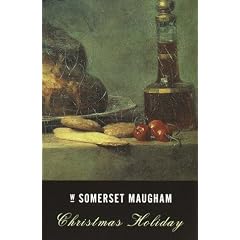
Christmas Holiday, first published in 1939, is a later Maugham novel that receives no favors from his archaic, straightlaced prose. Though effective at times, his storytelling doesn't fit the era it is depicting and reads like a 1930s social commentary through the eyes of Anthony Trollope. Published just before the outbreak of World War II, it is an unbalanced, often neurotic tale in which Maugham seems to be fighting against developments that endangered western tradition. It is difficult for an author of Maugham's talent to write a 'bad' novel, but he was extremely close with Christmas Holiday to achieving the feat.
Set in 1930s Paris, Christmas Holiday is divided into ten lengthy chapters. The focal character is Charley Mason, a 23-year-old Cambridge graduate and descendant of a property-owning family who is vacationing alone on Christmas week. Most of his dealings are with Simon Fenimore, a boyhood friend now working as a journalist, and Lydia, a Russian prostitute to whom Simon introduces him. As a sensitive, artistic young man who acts out of pity for her sordid lifestyle, Charley travels through the city and shares a depressing hotel room with Lydia for nearly his entire visit.
Charley's trip becomes something of an underground odyssey. Lydia is the wife of Robert Berger, a thief who was sent to French Guiana for murdering a horse racing bookie. We learn through her recollections and those of Simon, who covered Berger's trial, about a love affair with tragic results. These accounts, told in flashback style, carry a high amount of suspense and are made quite interesting by the fact that Simon, a devoted nihilist, was amused by Berger's personality. Charley also encounters the Russian refugee community and two survivors of Guiana who further build up his perspective on life.
Maugham, who was 65 at the time of Christmas Holiday's publication, seems to be rehashing a great deal of his earlier novels. Charley's initial dilemma of becoming an artist and earning decent income is akin to Charles Strickland in The Moon and Sixpence, while his dealings with Lydia and her sexual ambivalence mirror Philip Carey with Mildred Rogers in Of Human Bondage. The deceit and violence of Robert Berger can also be found in several of Maugham's writings, especially his short story 'The Letter.' For those acquainted with his fiction, Maugham seems to be walking old territory and desperate to understand the social landscape where tradition and values were falling apart.
Aside from subject matter, Christmas Holiday is sloppy in execution and in need of a rewrite. Maugham's characters sometimes break from their personality for no reason at all (Lydia suddenly jumps into a well-turned argument on politics) and the use of flashback and story-within-story cuts into the novel's pace as a whole. The book seems to lag and never really catches fire the way it should. Christmas Holiday manages to be engaging, but it ranks far below classics like Razor, Of Human Bondage, and The Painted Veil. I would only recommend it to Maugham completists and those with an appreciation of Paris during the Great Depression.
Maugham's novels are available in softcover from Vintage Classics, while I have on my bookshelf (but not for long) a hardback copy of its 1939 printing from P. F. Collier & Son. Released in 2000, the Vintage edition appears to reuse Collier's original type, which is large and clear. All of Maugham's fiction, however, is worth reading.

