Edited by William Douglas-Home, written and researched by Jennifer Browne
1987 (reprinted 1993) • Barnes & Noble Books
287 pages / ISBN 1566193559 (hardcover)
With the recent entrance of David Cameron as British Prime Minister, I decided to familiarize myself, once and for all, with his predecessors. This involved breaking open a title that was on my bookshelf for years. There is a first time for everything.
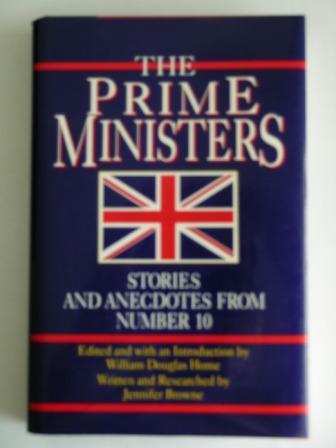 Originally published in 1987, The Prime Ministers: Stories and Anecdotes from Number 10 is a 287-page leisure title that sketches everyone who has held office from Robert Walpole to Margaret Thatcher. There has not been a second edition of this book, which leaves us four PMs short, but it covers the British premiership with an ease and briskness that is not often found in historical writing.
The book was edited by William Douglas-Home, a brother of Prime Minister Alec Douglas-Home, who served from 1963 to 1964. William himself ran unsuccessfully for seats in parliament and was known mainly as a dramatist and screenwriter. With research assistance from Jennifer Browne, The Prime Ministers offers a snapshot of each PM in history, including a page-long biography and select moments from his or her life.
Douglas-Home and Browne did not intend to write political commentary. Government issues are mentioned, but their book is purely leisure reading; the PMs are discussed as average individuals rather than as parliamentary figures. Douglas-Home makes this clear in his humorous, nine-page introduction, which attempts to rid the topic of its unpleasantness. Each PM's background, including his or her childhood, family life, and pastimes, is spiritedly described using letters, diaries, and other contemporary sources.
While The Prime Ministers never offers itself as a book of politics, it could have supplied a bit more in this area. I find it interesting to read about leaders' challenges, but these were minimized by Douglas-Home and Browne in order to sketch the PMs as regular human beings. Readers with larger political interests might wish that these facts were included.
Many earlier lives also feel dry and repetitive through no fault of the authors: these PMs seem to have eaten, slept, written letters, attended meetings...and not much else. Lives were simpler in those days and perhaps certain interesting details weren't talked about as freely. As a result, I didn't feel the book picking up steam until that renowned era of Disraeli and Gladstone. Newer PMs grabbed far more of my attention, especially when covering the twentieth century and meeting figures like Henry Asquith, Clement Attlee, and Harold Macmillan.
Yet even with these shortcomings, it is impossible not to learn a thing or two when reading Douglas-Home and Browne's heavily-researched book. The Prime Ministers follows a clear line of succession from 1721 and leaves you knowing a little something about everyone - including why Archibald Primrose dropped out of Oxford and how Henry Campbell-Bannerman felt about writing his name. It is recommended for anyone with an interest in politics or dynamic people and can serve as a handy reference.
The Prime Ministers was first sold as a British hardback by W. H. Allen in 1987 and reached America through Barnes & Noble Books in 1993. Used copies are still available at various sources on the Internet. Hopefully, it will be updated at some point to include all PMs from 1721 to 2010.

